Stamp condition faults: what each one does to the price
Condition decides more of a stamp’s price than age, and usually more than rarity. Here is what each common fault does to value, with a guide to each one.
Two copies of the same catalogue number can differ in price by a factor of fifty, and nothing about them differs except their physical state. The catalogues — Scott, Stanley Gibbons, Michel, Yvert & Tellier — price a stamp assuming sound condition, so a fault is never in the printed number: the discount is left to negotiation, and buyers negotiate hard once they find one.
None of these guides gives a fixed percentage for a fault, because there isn’t one. On a common stamp a serious fault can remove almost all of the value; on a genuinely scarce stamp the price falls, but the scarcity does not disappear.
The common faults at a glance
| Fault | Typical effect on price |
|---|---|
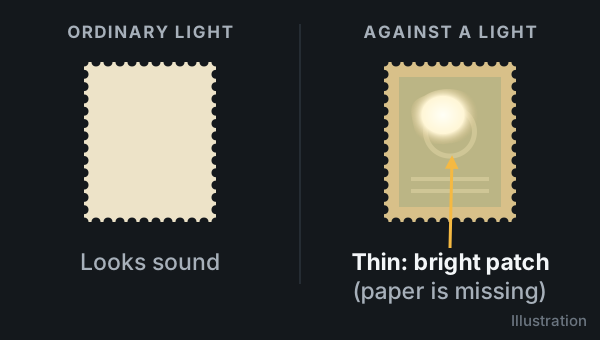
| Thin | Common stamp: a small fraction of its sound price. Rare stamp: can keep meaningful value. |
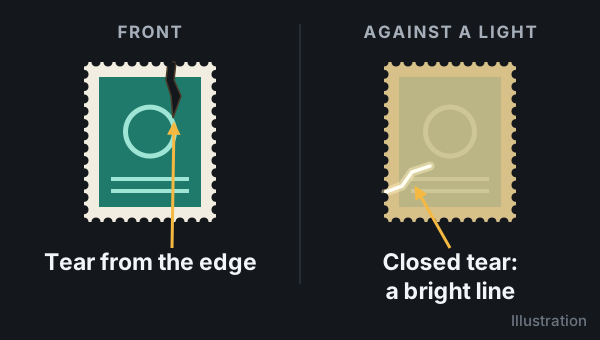
| Tear | Usually a small fraction of a sound copy; a margin-only tear is judged more leniently. |
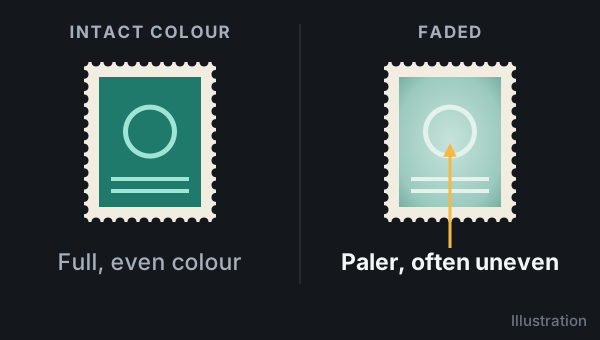
| Fading | Below the same stamp with intact colour; heavy fading is discounted like damage. |
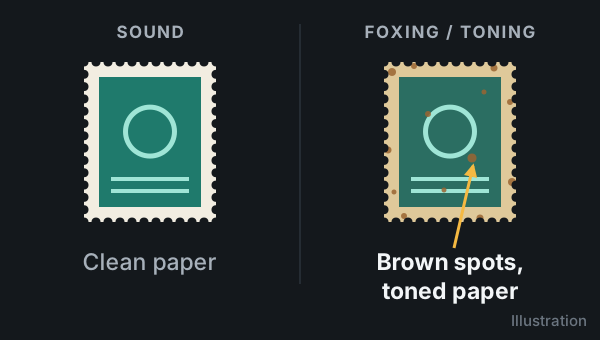
| Foxing, gum bloom, mould | Foxing makes the stamp faulty; bloomed gum drops a mint stamp out of the top grade. |
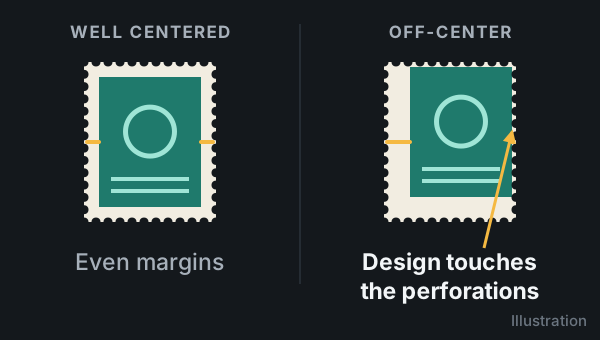
| Off-center design | A badly off-center copy can be worth a small fraction of a well-centered one. |
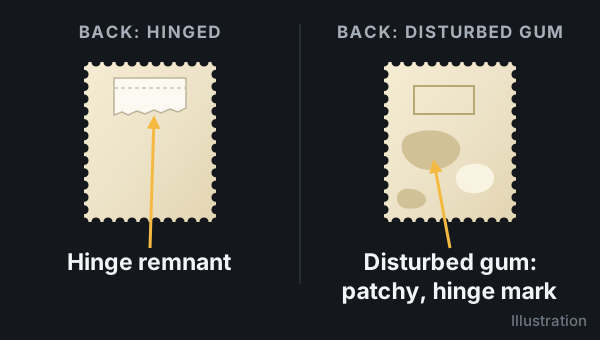
| Hinged or disturbed gum | A fraction of the quoted mint figure, sometimes less than a good used copy. |
To check a stamp fault by fault, use the stamp condition value estimator: tick what you see and it gives the typical effect on price, with the guide for each fault.
Each line is a summary of the linked guide. Before you do anything to a damaged stamp, read the guide first: a filled thin is still a repair, added colour counts as an alteration, and a cover should not be soaked until you know what it is.
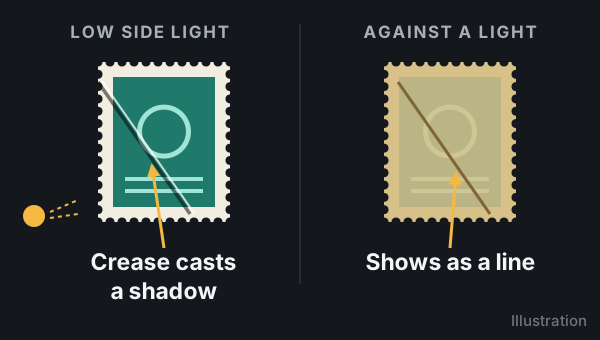
The faults, one guide each
Thinned Stamp Value: How to Spot a Thin and What It Costs
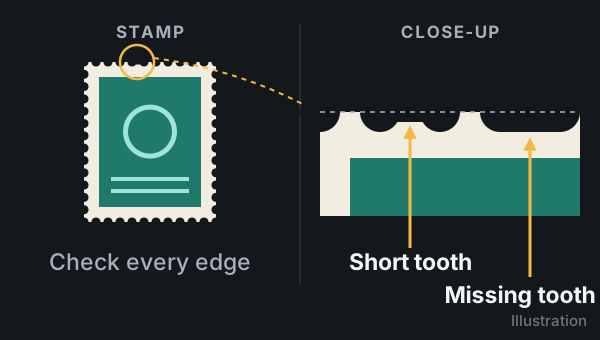
A thin is permanent damage to the paper. A common stamp with one can drop to a small fraction of its sound price; a genuinely rare stamp can still carry meaningful value.
Read the guide →Torn Stamp Value: What a Tear Really Does to the Price
Usually a small fraction of a sound copy. A tear confined to the margin is judged more leniently than one that runs into the design.
Read the guide →Faded Stamp Value: What Light Damage Really Costs
Almost always worth less than the same stamp with its colour intact. Fading is permanent, and heavy fading is discounted the way damage is.
Read the guide →How Humidity Ruins Stamp Value (Keep It at 40–55%)
Foxing makes a stamp faulty however rare it is, and softened or bloomed gum drops a mint stamp out of the top grade. Most guidance says keep relative humidity at roughly 40–55%, stable.
Read the guide →Stamp Centering Value Impact: Why It Matters So Much
Two copies of the same issue can differ in price several times over on centering alone; a badly off-center copy can be worth a small fraction of a well-centered one.
Read the guide →Mint vs Used Stamp Value: Which Is Worth More?
Mint is generally worth more, but a hinged, disturbed or regummed stamp is worth a fraction of the quoted mint figure — sometimes less than a good used copy.
Read the guide →Things that look like faults, and often aren't
Perforation Gauge and Stamp Value: Why It Matters
The gauge is rarely worth anything on its own, but it decides which catalogue variety you own — and that can separate a common variety from a scarce one.
Read the guide →Soaking a Stamp Off an Envelope: Does It Lower Value?
For most used stamps on a common envelope, soaking changes nothing. It costs value on first day covers, covers with unusual postal history and items where the envelope is part of what is collectible.
Read the guide →Why Is My Stamp Worth Less Than Catalogue Price?
Catalogue value is a reference pegged to a specific grade, not a resale price. A dealer buying common stock in bulk pays a small fraction of it.
Read the guide →How the faults add up to a grade
Common questions
How much does a fault reduce a stamp's value?
There is no fixed percentage. It depends on the size and position of the fault and on how scarce the stamp is: on a common stamp a thin or a tear can remove almost all of the value, because a buyer can find a sound copy for very little; a scarce stamp keeps some value even when damaged.
Which stamp faults are the most serious?
Tears and thins. A tear is visible from the front and cannot be undone; a thin is permanent damage to the paper and weakens the stamp. Fading and humidity damage such as foxing are also permanent, and buyers price them as damage.
Should I repair a damaged stamp before selling it?
No. A filled or backed thin still counts as a repair, and added colour on a faded stamp counts as an alteration. An undisclosed repair found later costs more than an honestly described fault, so describe the fault plainly and price it accordingly.
Check a stamp’s condition in seconds
StampWorth identifies the stamp from a photo, grades its condition, suggests its catalogue numbers and gives an AI estimate of its market-value range — a starting point, not a sale price. Free to download on iPhone and Android: 3 identifications a day, and your first valuation shows its full value; Pro shows every value.